Waskita
What it is
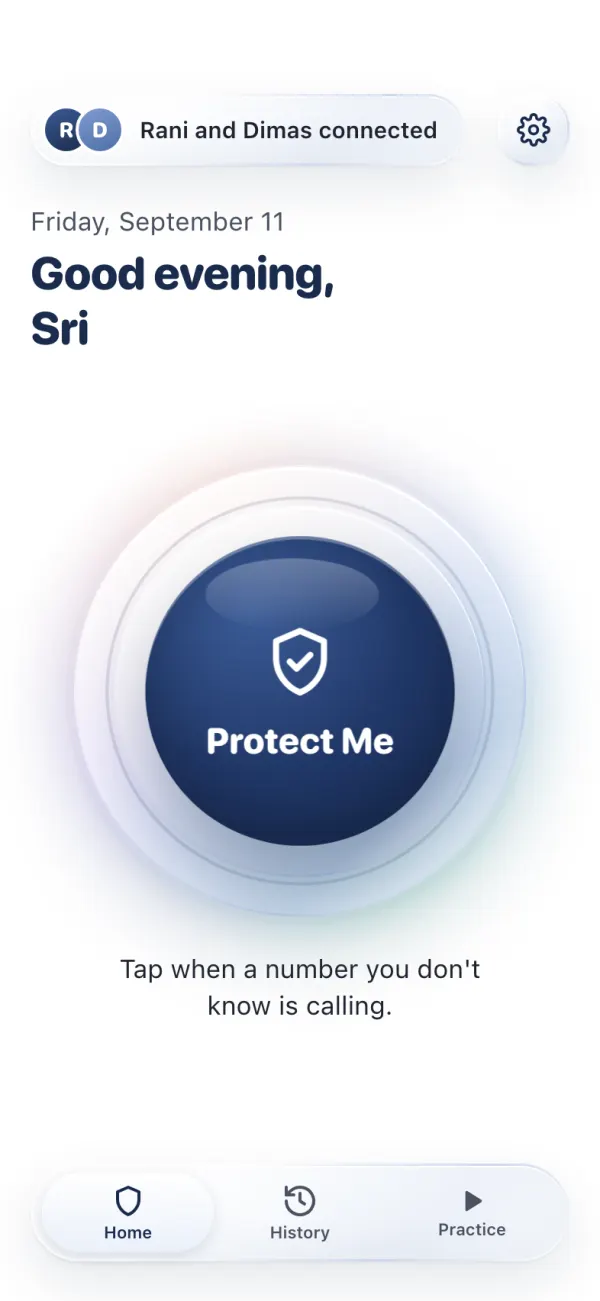
An iPhone app that listens to a live call, scores the risk on the device, and warns a family member.
Who it's for
Older parents who answer calls from strangers, and the adult child who wants to step in before an OTP is read out.
How it works
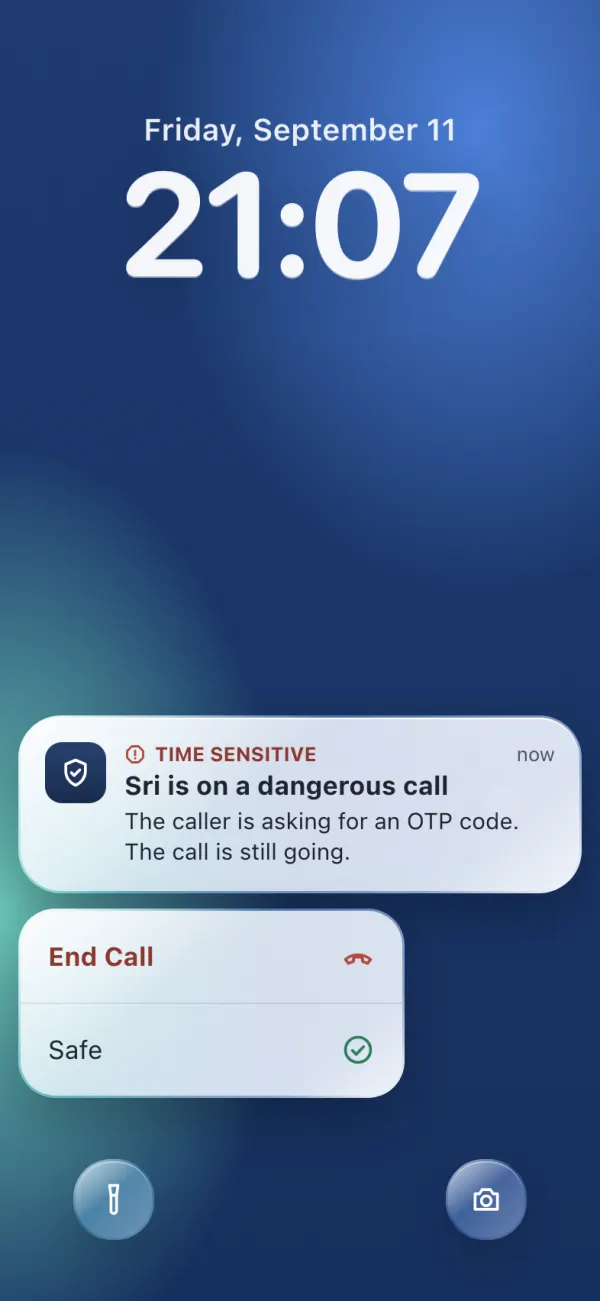
Speech is transcribed on the phone, a weighted risk lexicon scores it, and a sealed alert reaches the child's phone while the call is still running.
The problem
Context
Phone scams in Indonesia rarely start with a suspicious number. They start with a calm voice that slowly builds pressure until an older parent reads out an OTP. Indonesia's Anti-Scam Centre had logged 668,441 reports by August 2026.
Waskita listens to what is said in the call, on the device, and alerts a trusted family member while the call is still happening.
What we learned first
Competitors split the problem in two. Google's Scam Detection reads the conversation and has no family layer. Truecaller Family Protection has a family layer and only judges phone numbers. No one combined both, in Indonesian, on iPhone.
The dangerous moment is the handoff between phases. A warning that arrives after the call ends can only report the damage.
Constraints
- iOS gives third-party apps no access to cellular call audio
- Everything must stay on-device; a scam detector that uploads calls is its own privacy risk
- Parents are not the ones who will set up an app
My role
Richard on this project
PM, designer & iOS developer (solo)
Product skills
- Competitive benchmarking
- PRD & TRD
- Privacy by design
- Product states
Project skills
- Solo delivery
- Swift & backend
- Automated testing
- End-to-end device testing
As product manager
- Benchmarked global scam-call apps before writing the PRD and TRD
- Set the privacy model: audio is processed on the device
- Made Danger a state that never downgrades itself
As project manager
- Planned and built it solo, from the Swift app to the pairing backend
- Kept 71 automated tests green across app and backend
- Verified the whole flow end to end on two real devices
Not my role
- No team, so every trade-off was mine to make and to explain
The work
Key decisions & trade-offs
- Decision 01
Pivot when the platform said no
Building the prototype proved what the SDK headers confirm: an app cannot record during an active cellular call. So I moved calls onto Waskita's own VoIP path (CallKit + WebRTC) and added a Practice mode as a reliable demo rail.
Trade-off Protection only covers calls made through Waskita, and the product states that limit openly.
- Decision 02
Share only the evidence
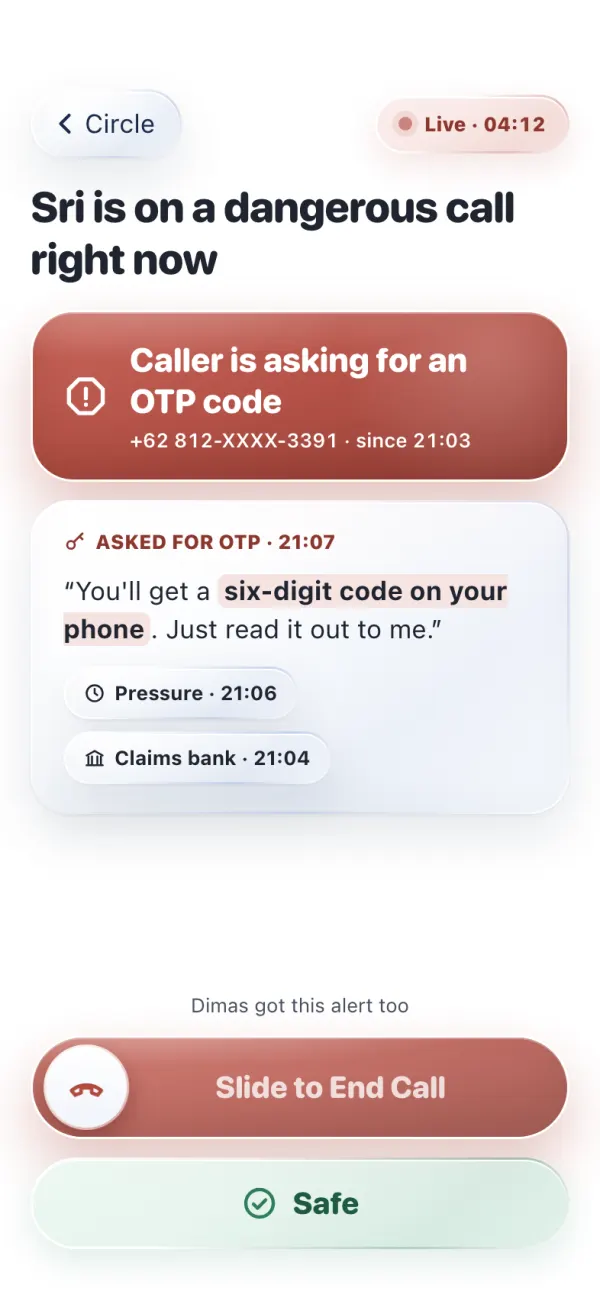
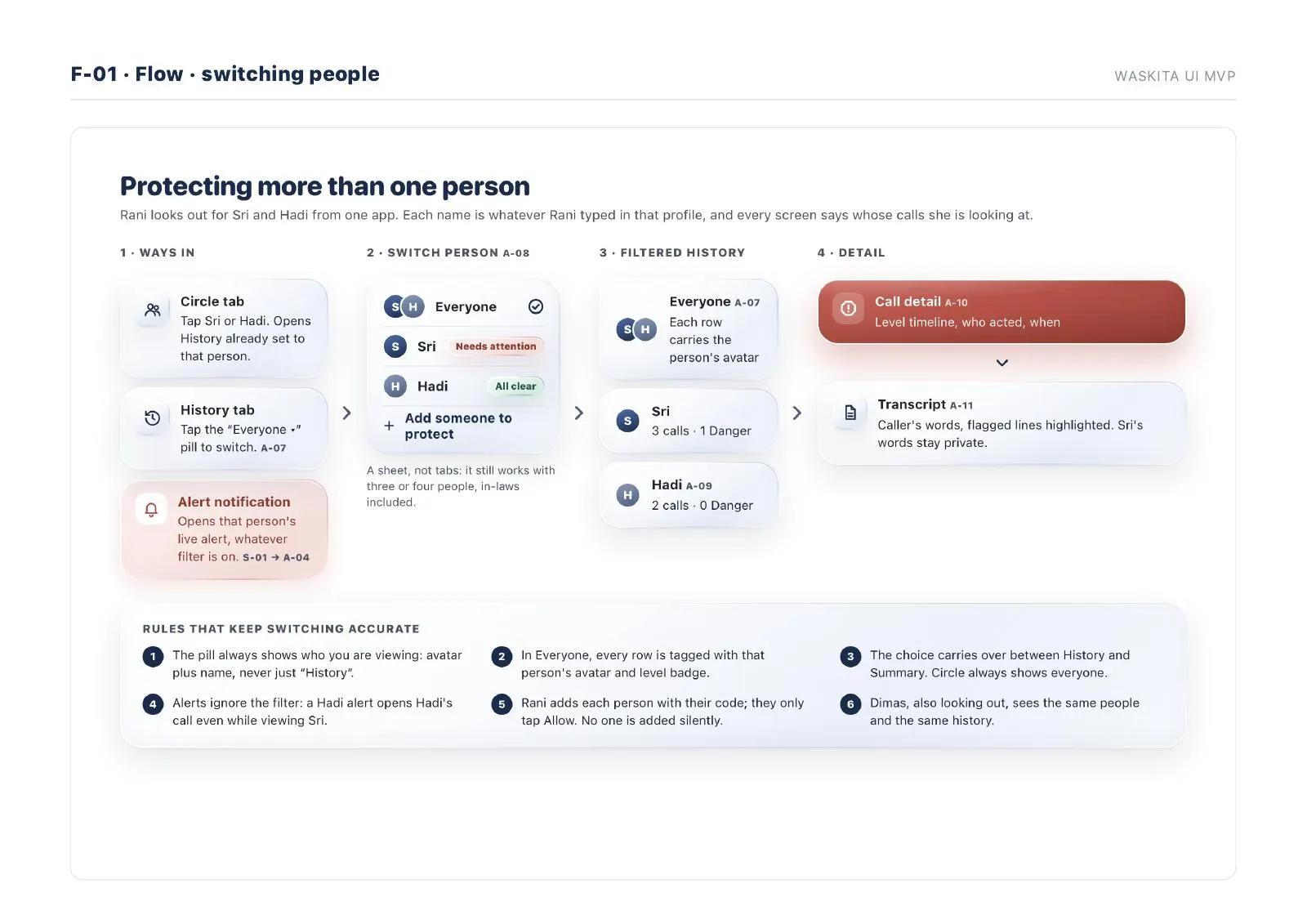
The child sees at most three caller sentences that triggered the alert, with the phrase highlighted and a reason label. The full conversation never leaves the parent's phone.
Trade-off Less context for the child, far more dignity and trust for the parent.
- Decision 03
Put the setup burden on the protector
The child requests a code, types it and sets the profile. The parent only shows a code and taps Allow. I also removed a four-word verification step to keep pairing to a 6-digit code.
Trade-off Simpler pairing drops one layer of MITM protection; I documented what remains (TLS, one-time 2-minute code, peer pinning, two-sided consent).
How it was built
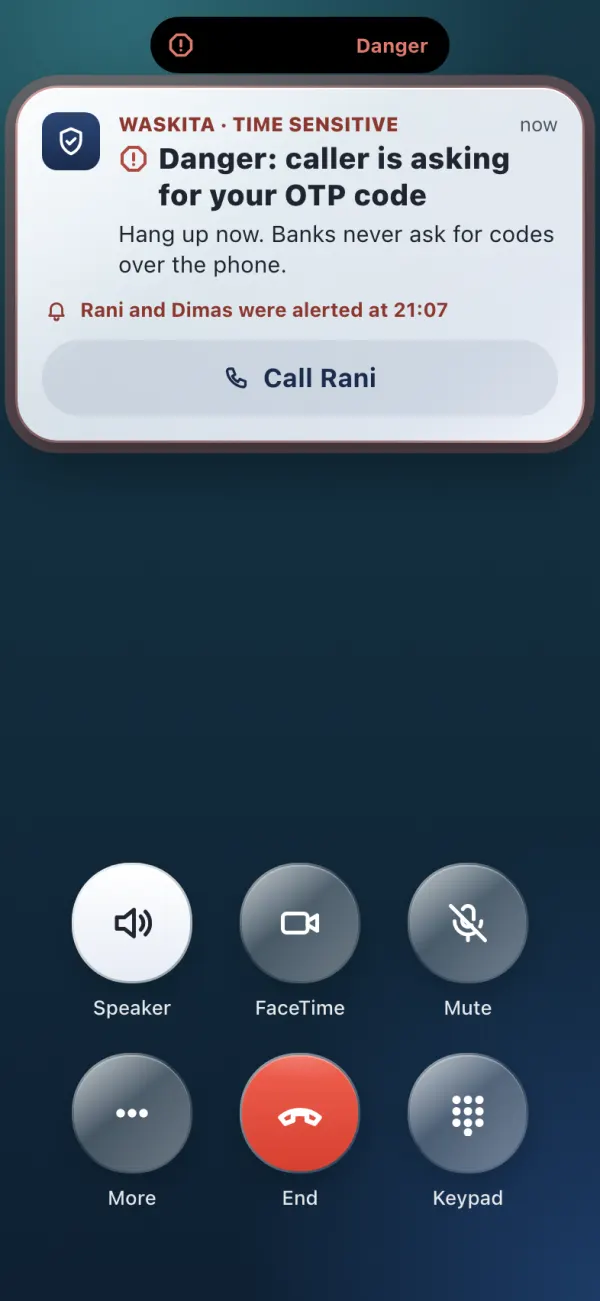
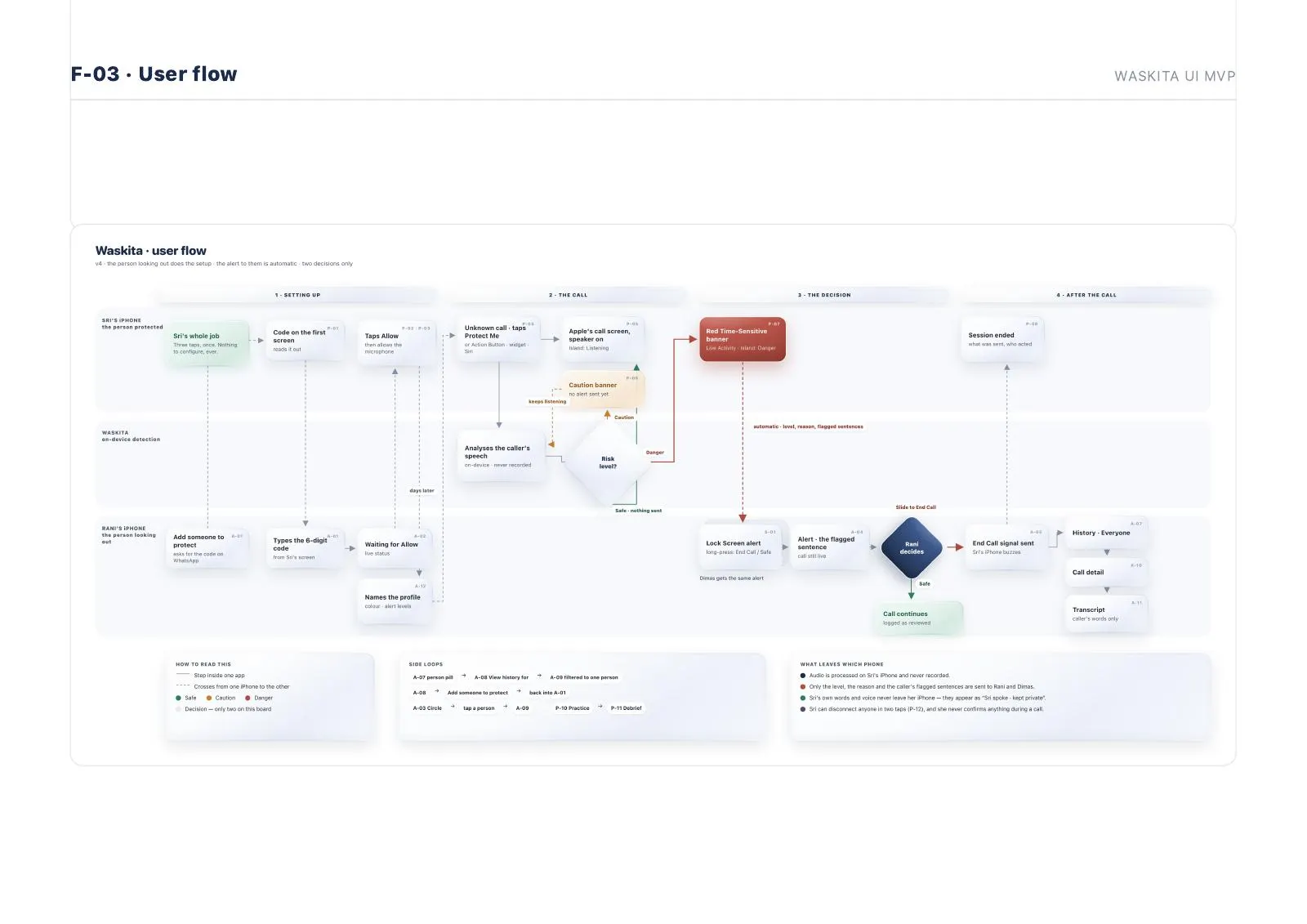
On-device transcription, a weighted risk lexicon (Indonesian + English), a state machine with debounce and hysteresis where Danger never downgrades itself, and a sealed alert envelope (AES-GCM) relayed to the child.
55 Swift core tests and 16 backend tests; verified across two devices: pairing, live analysis, Danger escalation at the OTP sentence, alert on the child's phone.
- Call answeredAnalysis starts on its own
- ListeningOn-device transcription
- CautionPressure words, claims to be a bank
- DangerAsks for OTP; never downgrades itself
- Child alertedMax 3 sentences, sealed
From the work itself
The result
- 2
- real devices talking end to end
- 71
- automated tests passing
- 32
- designed screens & flows
What I'd do differently
I would test platform limits in week one, before the PRD promised anything. The pivot cost less because I found it early, but it could have cost nothing.
Indonesian on-device transcription is not available yet, so the live demo runs in English. Next: test with real parent-child pairs.